In 1974, Serbian artist Marina Abramović stood inside a gallery in Naples, Italy, and told the audience they could do whatever they wanted to her for six hours. She would not move or react, no matter what.
On a table were 72 objects, including a rose, a feather, scissors, a gun, and a bullet. The performance was called “Rhythm 0.” The rules were simple. The crowd could use any object on her body in any way they chose, and she took full responsibility for whatever happened. At first, the audience was gentle. They handed her the rose and kissed her cheek. But as the hours passed, the crowd realized she truly would not fight back. They cut off her clothes with the scissors. Someone sliced her neck with a razor blade and drank the blood. Others carried her around the room and laid her on a table.
One man pressed a knife between her legs. Then someone loaded the gun, put it in her hand, and pointed it at her own throat. A fight broke out in the crowd before anyone could pull the trigger. When the six hours ended, Marina moved for the first time. She walked toward the audience, bleeding and with tears in her eyes. Everyone ran out of the gallery, terrified to look into the eyes of the woman they had just tortured.
She gave ordinary people absolute power.
It only took them six hours to become monsters.
That's pretty weird.
Sort of a form of social contagion.
Show how brutal people can be when given free rein to abuse and torture someone.
Yeah, but it takes groupthink or mob mentality. Individuals tend to act much different than groups.
It's weird thing that happens to primates when we get groups..
Look at Jan 6 a few years back in DC..Once it started, it became a frenzy and I'm sure half those people had no intention of going that far..
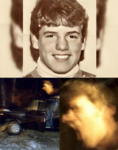
On a cold December night in 1984, four Minnesota teenagers set out on a routine drive that would instantly shatter into a lifelong nightmare. Among them was 16-year-old John Boulware, riding in the front passenger seat. As the car sped along a slick road near a St. Paul golf course, the driver lost control, slamming the vehicle violently into a tree. While three of the teens survived with minor injuries, John was killed instantly. What should have remained a tragic, straightforward accident instead mutated into one of the most chilling ghost stories in American criminal lore. When police officer Brian Coyle documented the wreckage with a traditional film camera, he captured a frame that would haunt law enforcement for decades. Developed in the darkroom, the image revealed a distorted, phantom face hovering above the crushed driver's side door, its mouth locked in a silent, agonizing scream. The facial structure and hair bore an unsettling resemblance to the fallen teenager. Dubbed "The Screaming Spirit," the photograph instantly polarized the public. Paranormal investigators argued it captured a soul abruptly ripped from the physical body, while skeptics pointed to accidental double exposures and trick photography. Decades later, whether viewed through the lens of the supernatural or the mechanical quirks of old film, the image remains an unforgettable ghost in the machine.
Attachments
__________________
Your name is being called by sacred things that are not addressed nor listened to. Sometimes they blow trumpets
For retired US Air Force veteran Sonny Graham, the overcast spring day in 2008 had begun like any other.
At about 7.30am, he had gone to his local store in Vidalia, Georgia, to buy supplies for his landscaping business and, on returning home, made himself a coffee and took it out to his shed.
But after placing the mug on a table next to him, Sonny shot himself dead.
For his family, their shock and grief were compounded by disbelief that he had chosen to end his life in the same way as 33-year-old Terry Cottle – the man whose suicide 13 years earlier had given Sonny a new chance of life.
Suffering from a diseased and enlarged heart as a result of a viral infection, Sonny received a transplant from Terry, whose family had agreed to his organs being donated after his death.
More extraordinary still, this was not the only way in which his life would mirror his donor’s. For, just two years after the transplant, he had sought out and fallen in love with Terry’s widow Cheryl, turning his back on his 38-year marriage to be with a woman he had known for only a few months.
What made Sonny take such actions? Was the heart transplanted into him somehow cursed – carrying with it Terry’s memories and character traits and driving him to end his life in the same way? Those were the questions asked by millions of TikTok viewers after Terry’s daughter Tiffany posted a video about the men’s shared fate in 2023. Now the story is the subject of Heart, a fascinating eight-part series available on Apple Podcasts.
In the following years, there were many claims made about heart transplants ‘transforming’ their recipients. One concerned a female schoolteacher who received a male heart and turned into ‘a beer-chugging, cigar-smoking, pro-wrestling fanatic’.
Another recipient, a lesbian activist, supposedly became heterosexual and, suddenly repelled by the smell of meat, stopped eating her favourite McDonald’s hamburgers. Her donor was a heterosexual vegan.
Far-fetched though these stories sound, there are convincing theories as to the mechanisms which might be at play.
Conventional science holds that memories are stored in the brain’s nerve cells, or neurons. But Dr Thomas Verny, a psychiatrist, author and former Harvard University lecturer, believes other cells in the body may have ‘memories’ of their own.
‘The differences between neurons and other cells in the body are really not that great, so whatever the neurons can do, the rest of the cells can do too,’ he says.
In his book The Embodied Mind, which explores the relationship between bodily processes and psychological experience, he describes how, in 2007, doctors examining a French civil servant, 44, discovered that most of the space inside his skull was occupied by fluid, leaving a comparatively thin layer of brain tissue. Yet he was married, had two children and held down a job.
How, Dr Verny wondered, could someone with so little brain tissue function so well?
He came to believe that cells throughout the body might act as a kind of biological backup system, storing information and contributing to memory and consciousness.
If any of this is true, might Terry Cottle’s heart have ‘remembered’ his feelings for Cheryl and could this explain the speed with which Sonny Graham fell for her as well?
__________________
Your name is being called by sacred things that are not addressed nor listened to. Sometimes they blow trumpets